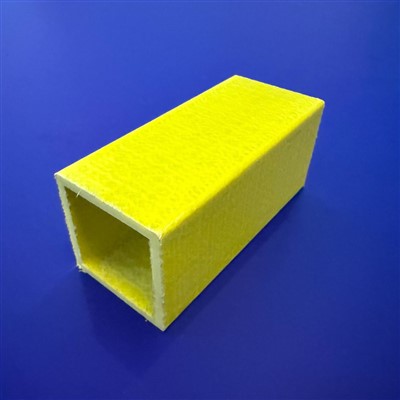
When it comes to FRP (Fiberglass Reinforced Plastic) square tubes, one of the most frequently asked questions is about their weight. As an experienced supplier of FRP square tubes, I'm here to shed light on this topic and provide you with comprehensive information.
Understanding the Basics of FRP Square Tubes
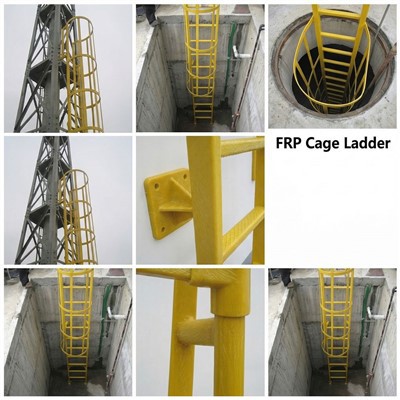
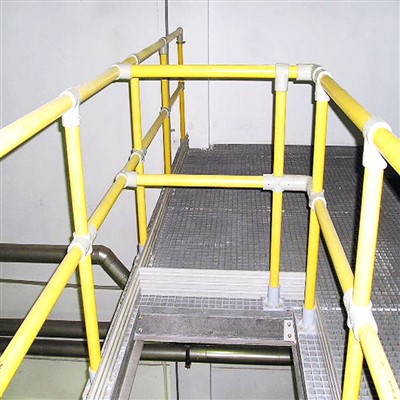
FRP square tubes are widely used in various industries due to their numerous advantages. They are corrosion - resistant, lightweight yet strong, and have good electrical insulation properties. These qualities make them suitable for applications in construction, transportation, and chemical processing, among others.
The weight of an FRP square tube depends on several factors. The first and most obvious one is the dimensions of the tube. The length, width, and wall thickness all play a significant role in determining the weight. Generally, larger tubes with thicker walls will weigh more than smaller ones with thinner walls.
Let's take a closer look at how these factors interact. For instance, if we consider two FRP square tubes with the same wall thickness but different side lengths, the tube with the larger side length will have a greater cross - sectional area. As a result, it will require more material to manufacture, and thus, it will be heavier. Similarly, for two tubes with the same side length, the one with a thicker wall will weigh more because it contains more FRP material.
Calculating the Weight of FRP Square Tubes
To calculate the weight of an FRP square tube, we need to know the density of the FRP material and the volume of the tube. The density of FRP typically ranges from 1.6 to 2.0 grams per cubic centimeter, depending on the specific composition and manufacturing process.
The volume of a square tube can be calculated by subtracting the volume of the inner square from the volume of the outer square and then multiplying by the length of the tube. Let's assume the outer side length of the square tube is (a), the inner side length is (b), and the length is (L). The volume (V) of the tube is given by the formula (V=(a^{2}-b^{2})\times L).
Once we have the volume, we can calculate the weight (W) using the formula (W = V\times\rho), where (\rho) is the density of the FRP material.


For example, if we have an FRP square tube with an outer side length (a = 10) cm, an inner side length (b = 8) cm, a length (L= 100) cm, and a density (\rho = 1.8) g/cm³. First, we calculate the volume:
[
\begin{align*}
V&=(a^{2}-b^{2})\times L\
&=(10^{2}-8^{2})\times100\
&=(100 - 64)\times100\
&=36\times100\
&=3600\text{ cm}^3
\end{align*}
]
Then, we calculate the weight:
[
\begin{align*}
W&=V\times\rho\
&=3600\times1.8\
&=6480\text{ g}\
&=6.48\text{ kg}
\end{align*}
]
Comparison with Other FRP Profiles
It's also interesting to compare the weight of FRP square tubes with other common FRP profiles, such as FRP U Channel, Fiberglass H Beam, and FRP Angle.
FRP U channels generally have a lower weight compared to square tubes of similar dimensions because they have a more open structure. The U - shape means that there is less material used in their construction. Fiberglass H beams, on the other hand, are designed to provide high strength and stiffness. They usually have a larger cross - sectional area and may weigh more than square tubes, especially when they are used in large - scale structural applications. FRP angles are relatively lightweight as well, as they are mainly used for corner reinforcement and have a smaller cross - sectional area.
Importance of Weight in Different Applications
The weight of FRP square tubes is a crucial factor in many applications. In the construction industry, for example, lighter tubes are easier to handle and install, which can reduce labor costs and improve efficiency. In transportation applications, a lower weight means less fuel consumption, which is not only cost - effective but also more environmentally friendly.
In chemical processing plants, the weight of the tubes can affect the overall stability of the structure. Lighter tubes may be more suitable for applications where the structure needs to be supported by a relatively weak foundation. However, in some cases, a certain amount of weight may be required to ensure the stability of the tube under high - pressure or high - load conditions.
Quality Control and Weight Consistency
As a supplier of FRP square tubes, we understand the importance of weight consistency. Our manufacturing process is carefully controlled to ensure that each tube meets the specified weight requirements. We use advanced production techniques and quality control measures to minimize variations in weight.
Before shipping our products, we conduct thorough inspections to ensure that the weight of each tube is within the acceptable range. This not only guarantees the quality of our products but also provides our customers with peace of mind.
Conclusion
In conclusion, the weight of FRP square tubes is influenced by factors such as dimensions, wall thickness, and the density of the FRP material. Understanding the weight of these tubes is essential for various applications, from construction to transportation. As a reliable supplier of FRP square tubes, we are committed to providing high - quality products with consistent weight.
If you are interested in purchasing FRP square tubes or have any questions about their weight or other properties, please feel free to contact us for a detailed discussion. We look forward to working with you to meet your specific needs.
References
- "Fiberglass Reinforced Plastic: Properties and Applications" - A comprehensive guide on FRP materials.
- Industry reports on the use of FRP profiles in different sectors.