Hey there! As a supplier of FRP T Profile, I often get asked about its acoustic performance. So, I thought I'd take a moment to share some insights on this topic.
First off, let's understand what FRP T Profile is. FRP stands for Fiber Reinforced Plastic, which is a composite material made of a polymer matrix reinforced with fibers. The T Profile is a specific shape of FRP, which is widely used in various industries due to its strength, durability, and corrosion resistance.
Now, let's talk about the acoustic performance of FRP T Profile. Acoustic performance refers to how well a material can absorb, reflect, or transmit sound. In the case of FRP T Profile, its acoustic performance is influenced by several factors.
One of the key factors is the material composition. FRP is made up of fibers and a resin matrix. The type of fibers and the resin used can have a significant impact on the acoustic properties. For example, some fibers may have better sound - absorbing capabilities than others. Additionally, the way the fibers are arranged within the resin matrix can also affect how sound waves interact with the material.
Another factor is the thickness and density of the FRP T Profile. Generally, thicker and denser materials tend to have better sound - insulating properties. A thicker FRP T Profile can absorb more sound energy and reduce the transmission of sound through it. However, this also needs to be balanced with other requirements such as weight and cost.
The surface finish of the FRP T Profile can also play a role in its acoustic performance. A smooth surface may reflect sound waves more effectively, while a rough or textured surface can help to scatter and absorb sound.
In practical applications, the acoustic performance of FRP T Profile can be quite useful. For instance, in industrial settings where there is a lot of noise, using FRP T Profile in partitions or enclosures can help to reduce the noise level. It can also be used in architectural applications, such as in building facades or interior partitions, to improve the acoustic comfort of the space.
Let's compare FRP T Profile with some other FRP products in terms of acoustic performance. Take FRP Flat Bar for example. While the flat bar has its own set of advantages in terms of strength and versatility, its acoustic performance may be different from the T Profile. The shape of the T Profile allows it to have a different sound - absorption and reflection pattern compared to the flat bar.
Similarly, Fiberglass H Beam has a different structure and geometry. The H - beam's design may be more focused on structural support, but it can also have some acoustic properties. However, due to its different shape and dimensions, the way it interacts with sound waves will be distinct from the FRP T Profile.
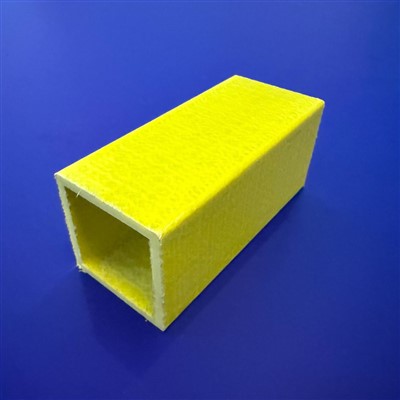
FRP Square Tube is another common FRP product. The tubular shape of the square tube can cause sound waves to travel and reflect in a unique way. Depending on the application, it may offer different acoustic benefits compared to the T Profile.
When it comes to measuring the acoustic performance of FRP T Profile, there are several methods. One common method is to use a sound absorption coefficient test. This test measures how much sound energy is absorbed by the material at different frequencies. Another method is to measure the sound transmission loss, which indicates how well the material can prevent sound from passing through it.
In real - world scenarios, the acoustic performance of FRP T Profile can be optimized through proper installation and design. For example, adding insulation materials behind the FRP T Profile can further enhance its sound - insulating capabilities. Also, the way the T Profiles are connected and assembled can affect the overall acoustic performance.
As a supplier, I've seen how different customers have used FRP T Profile for various acoustic applications. Some customers use it in manufacturing plants to reduce machine noise, while others use it in commercial buildings to create quiet workspaces. The versatility of FRP T Profile in terms of its acoustic performance makes it a great choice for many projects.


If you're considering using FRP T Profile for your acoustic needs, I'd be more than happy to discuss it with you. We can talk about the specific requirements of your project, such as the desired sound - absorption level, the environment where it will be used, and the budget. Whether you're an architect, an engineer, or a project manager, I'm here to help you make the best decision.
So, if you're interested in learning more about FRP T Profile and its acoustic performance, or if you're ready to start a project and need some guidance, don't hesitate to reach out. We can have a detailed discussion and see how we can meet your needs.
References:
- Industry research on FRP materials and their properties
- Case studies of FRP T Profile applications in acoustic projects