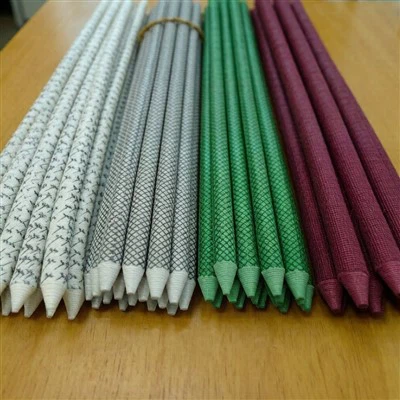
Fiberglass grating can be laid using specialized equipment such as tractors or modified trucks, but it is generally laid manually. Each roll of fiberglass grating has orange and blue markings at both ends. Before laying, the adhesive side should be facing down, and the markings should be on one end to facilitate construction and prevent incorrect installation. During installation, the grating should be kept flat and taut, with both sides aligned. A spirit level can be used to ensure it is level and has effective tension. After laying, it should be compacted with a clean steel-wheeled roller. This will make the grating clean, bright, and vibrant.
Commonly used fiberglass gratings are available with and without self-adhesive. Self-adhesive gratings can be laid directly on a leveled base layer, while non-self-adhesive gratings are typically fixed using stainless steel clips and nails. For ordinary road sections, fiberglass grating without self-adhesive is used. The materials required for fixing are:
① 50×50×0.3mm stainless steel fixing rings, which should be flat and without warped corners, and the edges should be chamfered;
② 2-inch steel nails.
When laying fiberglass grating using fixing nails or stainless steel fixing rings, first fix one end of the fixing ring and steel nail to the underlying structure that has been sprayed with tack coat asphalt. The steel nails can be driven in with a hammer or nail gun. Then, tighten the grating longitudinally and fix it in sections, each section being 2-5m long. Alternatively, it can be divided into sections according to the contraction joint spacing, with the steel nails placed at the joint gaps. It is required that the fiberglass be straight and taut in both the longitudinal and transverse directions when the grating is tightened.
The fiberglass grating overlap is longitudinal, with an overlap width of not less than 20mm, and a transverse overlap width of not less than 15mm. For longitudinal overlaps, the previous section should be placed on top of the next section according to the asphalt paving direction. When fixing the fiberglass grating, do not nail steel nails into it, and do not directly strike it with a hammer. If broken nails or loose retaining rings are found after fixing, it must be re-fixed. After the fiberglass grating is laid and fixed, it must be moderately compacted with a rubber roller to ensure a firm bond between the grating and the original road surface.
In actual construction, some construction units apply a tack coat and then directly lay the fiberglass grating, followed by compaction with a roller. This method yields good results, and the fiberglass grating is less prone to wrinkling. In practice, the quality of construction has a significant impact on the future performance of the fiberglass grating.