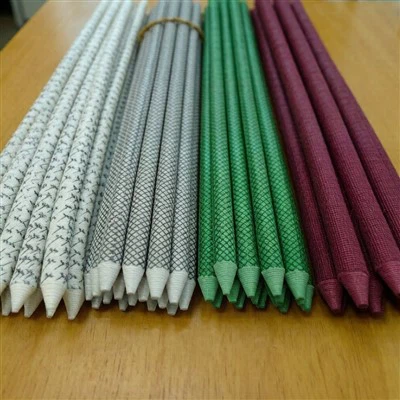
The main function of fiberglass ladder track profiles is to provide safe, stable, and insulated structural support for high-altitude operations. They are widely used in maintenance and repair work in high-risk environments such as power, telecommunications, and chemical industries.
These profiles are made of fiberglass reinforced plastic (FRP) as the base material, combined with high-strength resin. They are lightweight, high-strength, non-conductive, and corrosion-resistant, making them an ideal replacement for traditional metal ladder tracks.
Fiberglass has extremely high volume resistivity (>10¹² Ω·cm), allowing it to withstand live-line working environments with voltage levels of 220kV and below.
In scenarios such as substation and transmission line emergency repairs, it can effectively isolate current, ensuring the safety of workers.
The structure is stable and has a strong load-bearing capacity. The rectangular hollow or I-shaped cross-section design conforms to the principle of moment of inertia, providing strong bending resistance and preventing twisting deformation.
The ladder brace and ladder slats are connected in a semi-penetrating manner and reinforced by a solid round bar running through the entire structure, resulting in uniform stress distribution and reliable connection.
Corrosion resistant and adaptable to harsh working conditions
It has strong resistance to acids, alkalis, salt spray, and humid environments, making it suitable for corrosive locations such as chemical plants, sewage treatment plants, and coastal facilities.No painting required for rust prevention, virtually maintenance-free, and a service life of 15–20 years.